I guess it was unfair to drop a word like that without any explanation, so I thought I should update you all on my good Christian efforts to tame the savage tribes of Africa.
(That was sarcastic, in case you couldn't tell.)
A component of this study abroad program is an optional internship. You don't get any money for it or even academic credit, but since our only time commitment here is eight hours per week of class--that's it!--why not volunteer away some time? At Macalester, I often wish I could volunteer, but at Macalester, I don't have time to sleep, much less to give away.
So, Sara and I are volunteering at an orphanage called The Fact Foundation.
There are at least 50 kids there (I'm not sure how many precisely), ranging in age from toddlers to near adults. Generally, the foundation's policy is that the kids are on their own as of age 16, but one 25-year-old is allowed to stay because he suffered from spinal meningitis and has been mentally handicapped ever since. (They call him autistic, but I think that may just be their general word for mental handicaps, as opposed to referring specifically to autism.)
The younger kids sleep three to a bed, the older kids two. The beds aren't even twin beds--they're the size of summer camp bunks.
Their diet consists of two bowls of rice per day and bananas. Other sources of nutrition are sporadic: a social worker brings dates from time to time, and there are trees on the property that provide the occassional avocado or papaya. Generally, though, it's just white rice. Not enough protein for a growing kid, and I don't even want to know how constipated they must be...
Some of the kids attend school; others don't. I'm not sure why. The foundation pays for their tuition and uniforms (it's not a private school; that's just how it works here), so it's probably just that they can't afford to send them all to school. The kids brought home their report cards while I was there last week. Their grades were abysmal. I don't think anyone helps them with their homework.
Generally, the orphanage is a happier place than it is sad. Of course it's sad that these kids were abandoned, abused or just plain orphaned, but what's great about their atmosphere is that they have lots of brothers and sisters. I think it would be neat to grow up around that many kids. And no matter what, they're better off there than abused or on the street.
When we walk in, the younger kids run up to give us hugs. They call us both "Tantine" (Auntie). Some of them just want to hold our hands, others have lots of questions about the United States, and the older girls like to play with our hair.
(Women stroke my head here all the time. They admire white people's hair. If only they could see me when I'm not there's-no-running-water-to-shower greasy, holy-hell-this-humidity frizzy, and no-one-here-knows-how-to-cut-white-people's-hair split ends. And of course, it breaks my heart that the global standard of beauty has never embraced these girls, who tell me they wish they had hair like mine. I tell them that they're beautiful, but I'm no match for the global media industry.)
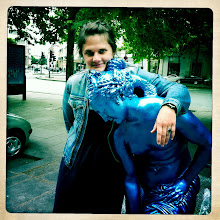
Here I am getting cornrows, which of course looked ridiculous. Today they gave me hanging braids, which also look ridiculous. (But thanks to Sara for the photo!)

So, generally, it's fun to visit the kids. It gets a little depressing when I notice how tattered the kids' clothes are, how thin they are and how beat up their (very few) toys are.
What's really depressing, though, is how much I hate the administrators. There are four men who run the orphanage, but a handful of women are there every day to wash the kids' clothes and prepare the daily rice. I think the women are volunteers from a local church, but no one's really explained that situation to me.
Since it's all Cameroonian men are capable and willing to do, the men sit around all day. If, hypothetically, children had no needs, it would be acceptable for these men to sit around all day. Oh but wait...there's something wrong with that picture. And speaking of pictures, here's evidence of what we're up against:

An administrator, sleeping soundly enough in his office that I was able to go retrieve my bag from a cabinet that doesn't open without a loud scraping noise.
The children's behavior is deplorable. They hit each other constantly.
Granted, Cameroonian people are more physical than Americans--they touch each other a lot more than we do, in general, and corporal punishment, specifically, is not frowned upon here as it is in the states. But seriously, I am the first person who has ever given these kids the use your words, not your hands lecture. (It's a Christian foundation, so I asked them if they thought Jesus would hit others. Things I never thought I would say...)
They run around with knives, and there's an ax lying around. Little boys pick it up and hack at pieces of 2 x 4's, and no one tells them not to.
When I tried to give an English lesson, as I'm supposed to do to make my time there productive, the kids did not shut up the whole time and the administrator guy who stood and watched didn't help me quiet them. He just watched me struggle to get their attention. What, then, was the point of his standing there?
Oh! And, two weeks in a row I've witnessed animal abuse. Well, actually, they don't care about animals in this country, so that term would fall upon deaf ears. Suffice it to say, things that would make a vegetarian flip out.
One time, a boy (nine? ten years old?) caught a little duck. Not a duckling, but not an adult either. He tied its leg to a string with which he then carried it around, swinging it in circles and poking it. He then put it out of its misery by hacking off its head with a dull knife.
(Why is he allowed to play with knives? Granted, my parents dealt with 48 fewer children, but knives, like dangerous chemical and matches, were stored out of our reach. That is common sense--something, I have discovered, Cameroonians lack.)
Yesterday, a little boy caught a baby bird, and, I think, squished it to death. However it died, it bled on his hands. And of course he thought it was hilarious to try to touch Sara and me with said hands.

I'm pretty confident that you can get bird flu that way, so I may start foaming at the mouth or something any second now. I would WebMD it if I thought the internet would cooperate.
In other words, playing with the orphans might kill me, and like any good colonizer, I am frustrated and wringing my hands at the futility of my efforts.
But, oh, for the good moments: